
Português
Portuguese for kids: learn it through everyday family life
By the Parler team · Updated · Read-aloud voices: Brazil, Portugal
The short answer
Start with your child's own day and the people in it. Use Portuguese for breakfast, bath time and calls with Vovó. Name what you see, repeat the same phrases every day, and read short stories about what your child did out loud. Parler turns your child's story into an illustrated Portuguese book that reads aloud with each word lighting up.
Portuguese is spoken in Brazil, Portugal, Angola, Mozambique, Cape Verde and other countries, with hundreds of millions of speakers. Brazil is home to most of them.
Kids learn Portuguese to talk with grandparents and cousins, to keep a family language alive far from home, or to get ready for a trip. The words that matter first are the everyday ones: family, food, school and play.
English speakers will recognize many words (família, animal, chocolate), and spelling is fairly regular. The harder parts are the nasal vowels, which English doesn't have, and the fact that Brazil and Portugal sound quite different from each other.
What’s different
What to know about Portuguese for a young learner
- Practice the nasal vowelsLetters like ão in irmão and ã in irmã are said partly through the nose. A word ending in m, like bem, is nasal too. In the respellings here, ng marks a nasal sound.
- Brazil and Portugal sound differentThe words are mostly the same, but the sound is not. Brazilian Portuguese is more open and sing-song, and European Portuguese swallows many vowels. The respellings on this page follow Brazilian pronunciation.
- Você or tuMost Brazilians say você for you, while in Portugal and some parts of Brazil children use tu with family and friends. Go with whatever your family or school uses.
- Accents change meaningAvó (ah-VAW) is grandma and avô (ah-VOH) is grandpa. The little mark tells you which one. Kids enjoy spotting the difference, and it teaches them to look closely at accents.
- Learn nouns with o or aNouns are masculine or feminine, and the word for the shows which: o gato, a casa. Learning the article with the word makes sentences easier later.
First words
Portuguese words for everyday life
Start with the words for their own day: home, family, school and play. They come up every day, so they stick.
| Portuguese | English | Say it |
|---|---|---|
| a casa | the house | ah KAH-zah |
| o gato | the cat | oo GAH-too |
| o cachorro | the dog (in Portugal: o cão) | oo kah-SHOH-hoo |
| a cozinha | the kitchen | ah koh-ZEEN-yah |
| a cama | the bed | ah KAH-mah |
| a mesa | the table | ah MEH-zah |
| a porta | the door | ah POR-tah |
| o jardim | the garden, the yard | oo zhar-JEENG |
| Portuguese | English | Say it |
|---|---|---|
| a mãe | mom, mother | ah MYNG |
| o pai | dad, father | oo PIE |
| o irmão | the brother | oo eer-MOWNG |
| a irmã | the sister | ah eer-MAHNG |
| a avó | grandma | ah ah-VAW |
| o avô | grandpa | oo ah-VOH |
| o bebê | the baby (in Portugal: o bebé) | oo beh-BEH |
| a família | the family | ah fah-MEE-lyah |
| Portuguese | English | Say it |
|---|---|---|
| a escola | the school | ah ehs-KOH-lah |
| o livro | the book | oo LEE-vroo |
| o lápis | the pencil | oo LAH-pees |
| a professora | the teacher (woman) | ah proh-feh-SOH-rah |
| o amigo | the friend (boy) | oo ah-MEE-goo |
| a mochila | the backpack | ah moh-SHEE-lah |
| o recreio | recess | oo heh-KRAY-oo |
| o desenho | the drawing | oo deh-ZEN-yoo |
| Portuguese | English | Say it |
|---|---|---|
| feliz | happy | feh-LEES |
| triste | sad | TREES-chee |
| cansado | tired (boy) | kahn-SAH-doo |
| brincar | to play | breeng-KAR |
| a bola | the ball | ah BOH-lah |
| o brinquedo | the toy | oo breeng-KEH-doo |
| rir | to laugh | HEER |
| estou com medo | I'm scared | ehs-TOH kohng MEH-doo |
Family phrases
Portuguese phrases to use at home today
| Portuguese | English | Say it |
|---|---|---|
| Bom dia | Good morning | bohng JEE-ah |
| Eu te amo | I love you | EH-oo chee AH-moo |
| Me dá…, por favor? | Can I have…, please? | mee DAH … poor fah-VOR |
| Hora de dormir | Time for bed | OH-rah jee dor-MEER |
| Muito bem | Well done | MWEENG-too BENG |
| Boa noite | Good night | BOH-ah NOY-chee |
| Obrigado / Obrigada | Thank you (said by a boy / by a girl) | oh-bree-GAH-doo / oh-bree-GAH-dah |
| A comida está pronta | Dinner's ready | ah koh-MEE-dah ehs-TAH PROHN-tah |
| Vamos brincar? | Shall we play? | VAH-moos breeng-KAR |
| Tudo bem? | How are you? | TOO-doo BENG |
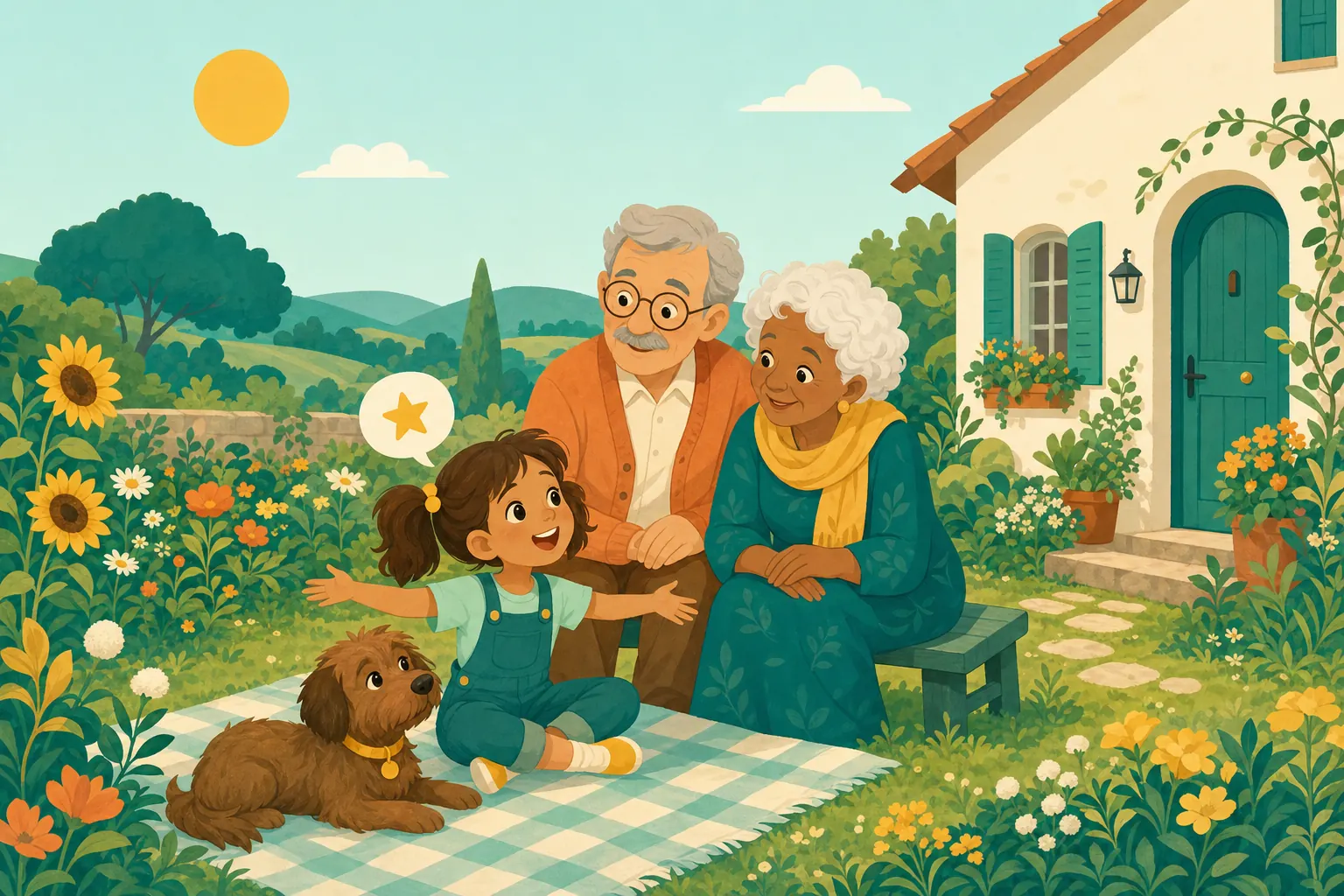
Hoje eu fiz um bolo com a vovó.
Today I made a cake with Grandma.
Questions
Portuguese for kids: questions
Short answers. The help center has more on using Parler.
Visit helpWhat age should my child start Portuguese?
Any age works. Young children copy the nasal sounds easily, and older kids can read along and spot the accents. Start when Portuguese can be part of your family's daily routine.
Which Portuguese does Parler use, Brazil or Portugal?
Parler has Portuguese read-aloud voices from both Brazil and Portugal. Pick the one that matches your family, so the books sound like the people your child talks to.
Is Parler free?
Yes, the First Page plan is free with 5 pictures a month for one learner. You can also try Storybook free for 14 days with 30 pictures and no card. Words, translations, voices and reading scores are always free.
Can my child learn Portuguese if we don't speak it at home?
Yes. Your child can hear Portuguese read aloud by a Portuguese voice while following each word on the page, so you don't need to pronounce everything yourself. Learning a few phrases together helps too.
How long does it take a child to learn Portuguese?
It depends on how much time your child spends hearing and using Portuguese. A little every day usually does more than a long session once a week, and everyday words come first.
Keep reading
- How do I keep a family language alive when my child is losing it?How to keep a heritage language alive when your child is losing it: daily routines, grandparents on video calls, family stories and real reasons to use it.
- How do I raise a bilingual child?How to raise a bilingual child: one parent one language, minority language at home, time and place, English-only answers, and why mixing languages is normal.
- How can I help my child learn a language I don't speak?Help your child learn a language you don't speak: learn alongside them, lean on native-speaker audio, involve relatives and make everyday routines the practice.