
Français
French for kids: learn it through everyday life
By the Parler team · Updated · Read-aloud voices: France, Canada
The short answer
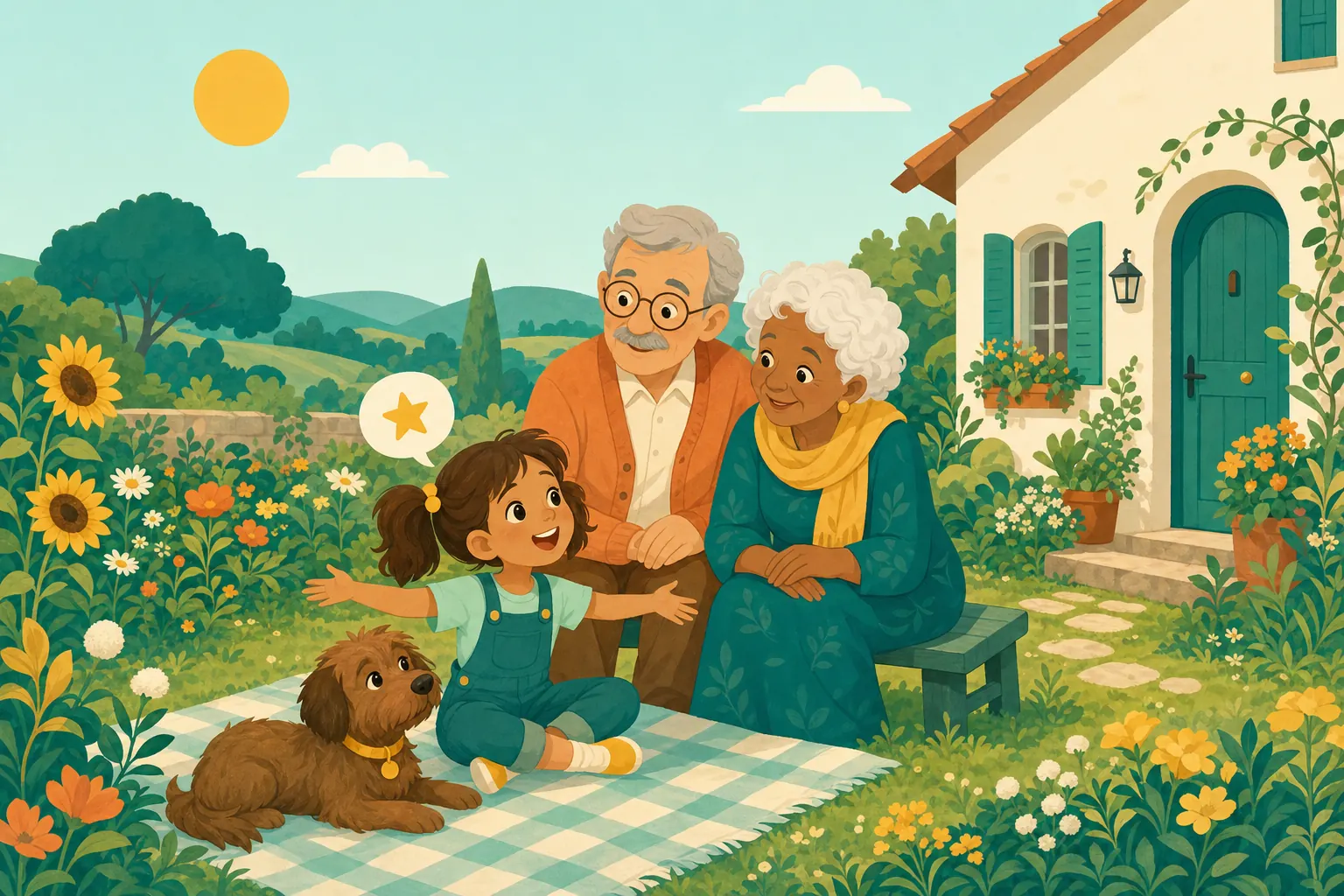
The easiest way in is your child's own life. Use French for the things you already do together: breakfast, bath time, a walk with Grandma. Name what you see, repeat the same phrases every day, and read short stories about their day out loud. Parler turns your child's story into an illustrated French book that reads itself aloud, word by word.
French is spoken in France, Canada, Belgium, Switzerland, Haiti and many countries across Africa. Hundreds of millions of people use it, and it is one of the most common languages taught in schools around the world.
Many kids learn French because a parent or grandparent speaks it, because they are in a French immersion program, or because the family travels to France or Quebec. In each case, the words that stick first are the ones from home: food, family, bedtime and play.
English speakers get a head start, since many words look familiar (table, animal, chocolat). The harder parts are the spelling, which often doesn't match the sound, and the fact that every noun is either masculine or feminine. Both get easier with lots of listening and reading along.
What’s different
What to know about French for a young learner
- Learn every noun with le or laFrench nouns are masculine or feminine, and there is often no clue in the word. Teach le chat and la maison together as one unit, never just chat or maison. The article comes for free that way.
- Many final letters are silentPetit, chocolat and grand all end in letters you don't say. This is why reading along with audio helps so much: your child sees the spelling and hears the real sound at the same time.
- Words link together in liaisonA silent final letter can wake up when the next word starts with a vowel. Les amis sounds like lay-zah-MEE. Kids pick this up by ear long before they need the rule.
- Tu for family, vous for the teacherFrench has two words for you. Children use tu with family and friends, and vous with teachers and adults they don't know well. Practice both in pretend play.
- Two new sounds: the French r and uThe French r comes from the back of the throat, and the u in tu is made with rounded lips and the tongue forward. Little ones copy these easily if they hear them often.
First words
French words for everyday life
Start with the words for their own day: home, family, school and play. They come up every day, so they stick.
| French | English | Say it |
|---|---|---|
| la maison | the house | lah meh-ZOHN |
| le chat | the cat | luh SHAH |
| le chien | the dog | luh SHYAN |
| la cuisine | the kitchen | lah kwee-ZEEN |
| le lit | the bed | luh LEE |
| la table | the table | lah TAH-bluh |
| la porte | the door | lah PORT |
| le jardin | the garden, the yard | luh zhar-DAN |
| French | English | Say it |
|---|---|---|
| la maman | mom | lah mah-MAHN |
| le papa | dad | luh pah-PAH |
| le frère | the brother | luh FREHR |
| la sœur | the sister | lah SUR |
| la mamie | grandma | lah mah-MEE |
| le papi | grandpa | luh pah-PEE |
| le bébé | the baby | luh bay-BAY |
| la famille | the family | lah fah-MEE-yuh |
| French | English | Say it |
|---|---|---|
| l'école | the school | lay-KOHL |
| le livre | the book | luh LEE-vruh |
| le crayon | the pencil | luh kreh-YOHN |
| la maîtresse | the teacher (woman, elementary school) | lah meh-TRESS |
| le copain | the friend (boy) | luh koh-PAN |
| la récré | recess | lah ray-KRAY |
| le cartable | the school bag | luh kar-TAH-bluh |
| le dessin | the drawing | luh deh-SAN |
| French | English | Say it |
|---|---|---|
| content | happy (boy) | kohn-TAHN |
| triste | sad | TREEST |
| fatigué | tired (boy) | fah-tee-GAY |
| jouer | to play | zhoo-AY |
| le ballon | the ball | luh bah-LOHN |
| le jouet | the toy | luh zhoo-EH |
| rire | to laugh | REER |
| j'ai peur | I'm scared | zhay PUR |
Family phrases
French phrases to use at home today
| French | English | Say it |
|---|---|---|
| Bonjour | Good morning, hello | bohn-ZHOOR |
| Je t'aime | I love you | zhuh TEM |
| Est-ce que je peux avoir… ? | Can I have…? | ess kuh zhuh puh ah-VWAHR |
| C'est l'heure d'aller au lit | Time for bed | seh LUR dah-LAY oh LEE |
| Bravo | Well done | brah-VOH |
| Bonne nuit | Good night | bun NWEE |
| Merci | Thank you | mehr-SEE |
| S'il te plaît | Please | seel tuh PLEH |
| À table | Dinner's ready (come to the table) | ah TAH-bluh |
| Tu veux jouer ? | Do you want to play? | tew vuh zhoo-AY |
Aujourd'hui, j'ai fait un gâteau avec Mamie.
Today I made a cake with Grandma.
Questions
French for kids: questions
Short answers. The help center has more on using Parler.
Visit helpWhat age should my child start French?
Any age works. Young children copy new sounds easily, and older kids can read along and notice spelling patterns. The best time to start is when you can make French part of a daily routine.
Which French does Parler use, France or Canada?
Parler has French read-aloud voices from both France and Canada. Families in Quebec or in Canadian immersion programs can use the Canadian voice, and others can use the voice from France.
Is Parler free?
Yes, the First Page plan is free with 5 pictures a month for one learner. You can also try Storybook free for 14 days with 30 pictures and no card. Words, translations, voices and reading scores are always free.
Can my child learn French if we don't speak it at home?
Yes. You don't need to speak French yourself if your child hears it read aloud by a French voice and sees the words as they hear them. Learning a few phrases alongside your child helps too.
How long does it take a child to learn French?
It depends on how much time your child spends hearing and using French. A few minutes every day usually does more than one long session a week, and everyday words come first.
Keep reading
- What's a great way to teach my child French?How to teach your child French at home: short daily habits, their own life as the material, read-aloud, songs and speaking back, with a plan by age and week.
- How can I support my child's French immersion at home if I don't speak French?How parents who don't speak French can support a child in French immersion: reading homework, school readers, strong English, the teacher and the summer break.
- Going to France? The French phrases to learn first (and how to learn them fast)The French phrases that do most of the work on a trip to France, with tables by situation, easy pronunciation, a 2-week plan and ways to get kids involved.