

The short answer
Give the family language a regular place in your child's day and a real reason to use it. Keep a few daily routines in the language, set up regular calls with grandparents, and make stories about the family itself. Children hold onto a language when it connects them to people they love, so lead with relationships, not drills.
Why do children lose a family language?
Children usually drift away from a family language because the community language takes over their day, especially once school starts. It is not a failure on anyone's part; it is what happens when one language is everywhere and the other is only at home.
Signs often look like this: your child understands everything Grandma says but answers in English, uses English words mid-sentence, or says the family language is "boring" or "for old people." These are signals to add warmth and reasons, not pressure.
How can I keep the family language going at home?
Protect a few daily moments for the family language and make them pleasant. A small, steady presence keeps the language alive more reliably than big efforts that fade.
- One protected routine. Breakfast or bedtime always in the family language.
- Talk about now. Describe what you are doing together, in the language, without quizzing.
- Food and recipes. Family dishes come with their own words and memories.
- Music from home. Songs your parents sang to you are part of the inheritance.
- Books and stories. Read aloud in the language, including stories about your own family.
- Accept partial answers. If your child replies in English, keep going warmly in your language.
How can grandparents help from far away?
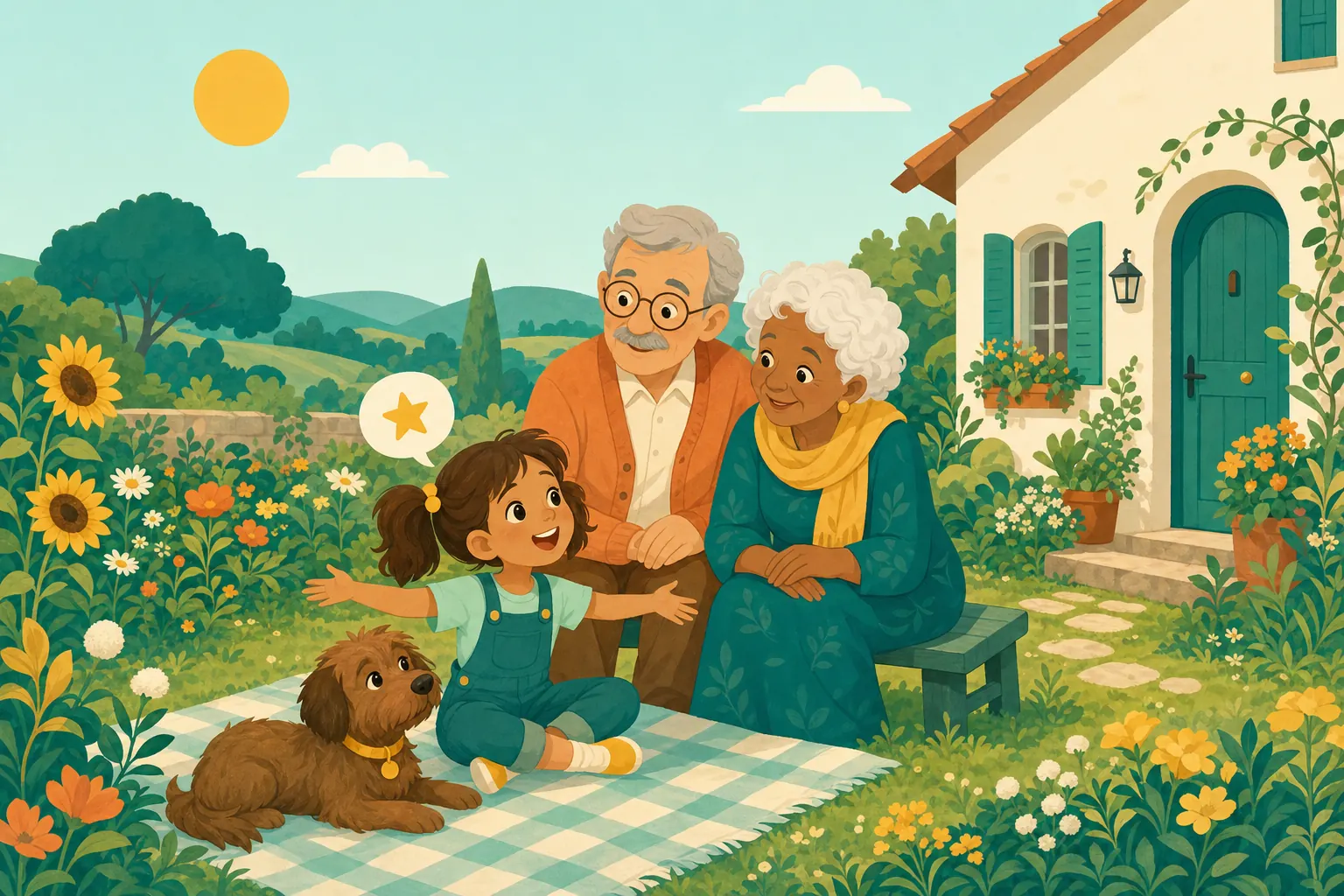
Grandparents are often the strongest reason a child has to keep a family language. Regular video calls, shared stories and small exchanges give the language a face and a voice, even across an ocean.
- Set a regular callSame day, same time, short and relaxed. Ten or fifteen minutes is plenty for a young child.
- Prepare one questionHelp your child plan a question beforehand, such as "Abuela, ¿cómo era tu casa cuando eras niña?" (Grandma, what was your house like when you were a girl?)
- Share somethingA drawing, a story about their week, or a page they read aloud gives the call a focus.
- Ask grandparents to tell storiesFamily memories in the family language are what children remember.
- Keep it going between callsSend short things back and forth: a photo of a drawing, a voice message, a little book.
Grandparents do not need to become teachers. Their job is to be themselves, in their language, and to be delighted to hear from their grandchild.
Some grandparents worry that they are not doing it right, or switch to English to make things easier. Gently ask them to keep speaking their language, slowly and with gestures, even if the child answers in English. Hearing a grandparent's real voice in the family language, week after week, is often what keeps a child connected to it.
Why are stories about the family so powerful?
Stories about the family give children something they actually want to say in the family language. A sentence like "Nonno ha fatto la pizza con me" (Grandpa made pizza with me) is easy to remember because it is about someone they love.
| Story idea | Example | Meaning |
|---|---|---|
| A visit to grandparents | On est allés chez Papi et Mamie. | We went to Grandpa and Grandma's house. (French) |
| A family meal | Mi abuela hizo tamales. | My grandma made tamales. (Spanish) |
| A family member's job | Mein Onkel ist Bäcker. | My uncle is a baker. (German) |
| A memory from the past | Quando la nonna era piccola, viveva in campagna. | When Grandma was little, she lived in the countryside. (Italian) |
| Today with a cousin | Brinquei no parque com a minha prima. | I played in the park with my cousin. (Portuguese) |
Write these down, read them aloud, and send them to the people in them. Each story becomes both practice and a gift.
Family stories also carry words that everyday chores never bring up: the name of a village, a holiday dish, a nickname only one aunt uses. Those are the words that make a heritage language feel like it belongs to your child, not just to the adults.
What should I avoid?
Avoid shame and avoid all-or-nothing rules. A child who feels criticized for their family language often pulls away from it.
- Don't mock mistakes or accents, and ask relatives to avoid it too.
- Don't refuse to answer English. Respond in the family language instead.
- Don't make it only about homework. The language should also mean jokes, food, songs and love.
- Don't wait for a better time. Small daily moments now matter more than a perfect plan later.
For the wider picture of growing up with two languages, see raising a bilingual child. If you are relearning the language yourself, learning a language as a family may help.
How can Parler help with a heritage language?
Parler is built for exactly this: stories about the people they love, in the language they are learning.
Parler has read-aloud voices for French, Spanish, German, Italian, Portuguese, Arabic, Mandarin Chinese, Japanese and English, with translations into many more languages. See how it works or pricing.