
Deutsch
German for kids: learn it through family life
By the Parler team · Updated · Read-aloud voices: Germany
The short answer
Tie German to your child's own day. Use it at breakfast, in the bath and on the way to school. Name the people and things around you, keep the same phrases every day, and read short stories about what your child did. Parler turns those stories into illustrated German books that read aloud with each word lighting up.
German is spoken in Germany, Austria, Switzerland, Liechtenstein and Luxembourg, and in parts of Belgium and northern Italy. It is one of the most widely spoken languages in Europe.
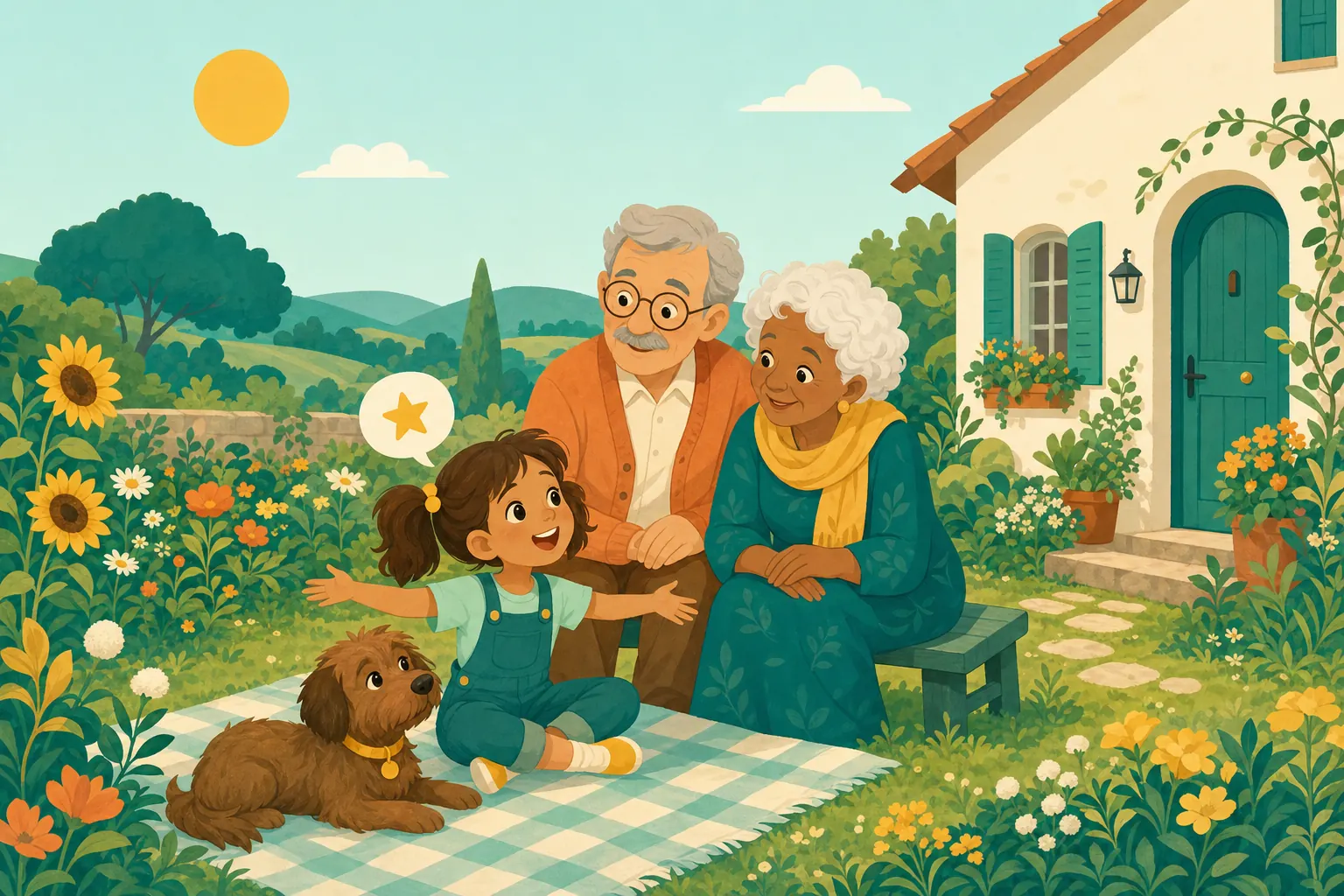
Many children learn German to talk with grandparents, to keep up at a German school abroad, or before a family move or trip. The first words that matter are the everyday ones: Oma and Opa, food, school and toys.
English and German are close cousins, so lots of words feel familiar: Hand, Haus, Garten, Apfel. The harder parts are the three genders, the way endings change in a sentence, and word order that puts the verb at the end of some sentences.
What’s different
What to know about German for a young learner
- Every noun starts with a capitalIn German, all nouns are capitalized, not just names: der Hund, die Schule, das Buch. Kids can use this as a clue when they read: a capital letter in the middle of a sentence means a thing.
- Learn der, die or das with each nounGerman has three genders, and the article is hard to guess. Teach the word and its article together, as in der Tisch and die Tür. Some families color-code them on sticky notes around the house.
- Build big words from small onesGerman glues words together. Schule (school) plus Ranzen (bag) makes Schulranzen, a school bag. Handschuh is a hand shoe: a glove. Kids enjoy taking long words apart like puzzles.
- Practice ü, ö and äThese letters have their own sounds. For ü, say ee and then round your lips. For ö, say ay and round your lips. Ä sounds like the e in bed. Respellings here write ü as ue.
- W sounds like v, and ch is softWasser sounds like VAHS-ser. The ch in ich is a soft hiss, and in Buch it is a scratchy sound at the back of the mouth, written kh in the respellings.
First words
German words for everyday life
Start with the words for their own day: home, family, school and play. They come up every day, so they stick.
| German | English | Say it |
|---|---|---|
| das Haus | the house | dahs HOWS |
| die Katze | the cat | dee KAHT-suh |
| der Hund | the dog | dair HOONT |
| die Küche | the kitchen | dee KUE-khuh |
| das Bett | the bed | dahs BET |
| der Tisch | the table | dair TISH |
| die Tür | the door | dee TUER |
| der Garten | the garden, the yard | dair GAR-ten |
| German | English | Say it |
|---|---|---|
| die Mama | mom | dee MAH-mah |
| der Papa | dad | dair PAH-pah |
| der Bruder | the brother | dair BROO-der |
| die Schwester | the sister | dee SHVES-ter |
| die Oma | grandma | dee OH-mah |
| der Opa | grandpa | dair OH-pah |
| das Baby | the baby | dahs BAY-bee |
| die Familie | the family | dee fah-MEE-lee-uh |
| German | English | Say it |
|---|---|---|
| die Schule | the school | dee SHOO-luh |
| das Buch | the book | dahs BOOKH |
| der Stift | the pen, the pencil | dair SHTIFT |
| die Lehrerin | the teacher (woman) | dee LAIR-uh-rin |
| der Freund | the friend (boy) | dair FROYNT |
| die Pause | recess, break | dee POW-zuh |
| der Schulranzen | the school bag | dair SHOOL-rahn-tsen |
| das Bild | the picture | dahs BILT |
| German | English | Say it |
|---|---|---|
| glücklich | happy | GLUEK-likh |
| traurig | sad | TROW-rikh |
| müde | tired | MUE-duh |
| spielen | to play | SHPEE-len |
| der Ball | the ball | dair BAHL |
| das Spielzeug | the toy | dahs SHPEEL-tsoyk |
| lachen | to laugh | LAH-khen |
| Ich habe Angst | I'm scared | ikh HAH-buh AHNGST |
Family phrases
German phrases to use at home today
| German | English | Say it |
|---|---|---|
| Guten Morgen | Good morning | GOO-ten MOR-gen |
| Ich hab dich lieb | I love you (the warm family way) | ikh hahp dikh LEEP |
| Kann ich … haben? | Can I have…? | kahn ikh … HAH-ben |
| Zeit zum Schlafen | Time for bed | tsite tsoom SHLAH-fen |
| Gut gemacht | Well done | GOOT guh-MAHKHT |
| Gute Nacht | Good night | GOO-tuh NAHKHT |
| Danke | Thank you | DAHN-kuh |
| Bitte | Please | BIT-tuh |
| Essen ist fertig | Dinner's ready | ES-sen ist FAIR-tikh |
| Willst du spielen? | Do you want to play? | vilst doo SHPEE-len |
Heute habe ich mit Oma einen Kuchen gebacken.
Today I baked a cake with Grandma.
Questions
German for kids: questions
Short answers. The help center has more on using Parler.
Visit helpWhat age should my child start German?
Any age works. Young children pick up the sounds easily, and older kids can use spelling and capital letters as clues when they read. Start when German can be part of a daily routine.
Which German does Parler use?
Parler reads aloud with a voice from Germany, speaking standard German. That is the German children learn to read and write in school in Germany, Austria and Switzerland.
Is Parler free?
Yes, the First Page plan is free with 5 pictures a month for one learner. You can also try Storybook free for 14 days with 30 pictures and no card. Words, translations, voices and reading scores are always free.
Can my child learn German if we don't speak it at home?
Yes. Your child can hear German read aloud by a German voice and follow each word on the page, so you don't need to pronounce everything yourself. Learning alongside them helps both of you.
How long does it take a child to learn German?
It depends on how much time your child spends hearing and using German. A little every day usually beats a long session once a week, and everyday words and phrases come first.
Keep reading
- How do I raise a bilingual child?How to raise a bilingual child: one parent one language, minority language at home, time and place, English-only answers, and why mixing languages is normal.
- How do I keep a family language alive when my child is losing it?How to keep a heritage language alive when your child is losing it: daily routines, grandparents on video calls, family stories and real reasons to use it.
- How can I help my child learn a language I don't speak?Help your child learn a language you don't speak: learn alongside them, lean on native-speaker audio, involve relatives and make everyday routines the practice.